
Birthing of Giants Private Deal Team Report: No Board Seat
8 Deal Points That Kill Lower Middle Market Deals
Deal Point #5: no Board Seat
Excerpted from https://privatedealteam.birthingofgiants.com/board-seat
Private equity is often associated with control.
Buy the company. Take the board. Replace leadership. Run a playbook.
But in today’s market, one of the fastest-growing PE strategies looks very different:
Minority investments where the PE firm intentionally does not take a board seat.
At first glance, this can look like a simple signal of trust in management.
In reality, it’s usually a highly strategic decision — shaped by legal risk, regulatory pressure, and the realities of a capital-rich private market.
The Shift: From Command to Contract
The modern private equity market has evolved dramatically.
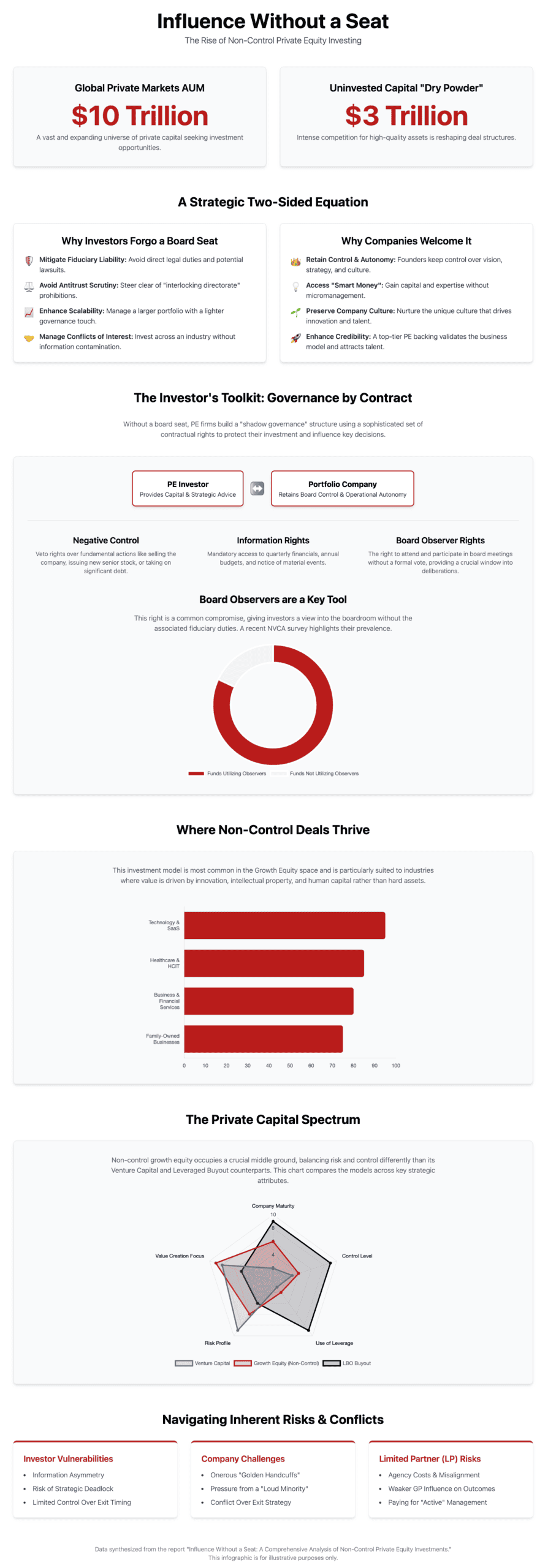
With trillions in “dry powder” competing for a limited number of high-quality assets, the power dynamic has shifted:
- Founders and management teams have more leverage
- High-growth companies have more financing options
- Control is no longer the default price of entry
So PE firms have adapted.
Instead of governing through the boardroom, many now govern through contractual architecture.
Why an Investor Might Avoid a Board Seat
This isn’t passive investing. It’s selective involvement — and often a form of de-risking.
1) Fiduciary liability Board members owe duties to the company and all shareholders, not the investor who appointed them.
Avoiding the seat reduces legal exposure, especially in distress scenarios.
2) Antitrust and regulatory scrutiny Section 8 of the Clayton Act (interlocking directorates) has become a much bigger issue — especially for sector-focused PE firms with multiple portfolio companies in the same space.
Not taking board seats can be a compliance strategy.
3) Scalability Board participation is time-intensive.
A non-seat approach lets partners manage a larger portfolio of minority investments without the governance load of dozens of boards.
4) Conflict management If you invest across a sector, board seats can create unavoidable conflicts (and information contamination).
A contractual governance structure can be cleaner.
Why Companies Often Prefer It
From the founder or CEO perspective, the appeal is obvious:
Control stays with the people who built the company.
That matters most in:
- SaaS and tech
- healthcare services
- founder-led professional services
- family-owned businesses
The company gets:
- growth capital
- credibility
- strategic help
- access to networks
…without giving up the steering wheel.
The Real Power: “Shadow Governance”
No board seat doesn’t mean no influence.
It usually means the influence moves into the documents.
PE investors often negotiate a strong toolkit, including:
Protective provisions (“negative control”) Veto rights over:
- M&A
- major debt
- new equity issuance
- changes to charter/bylaws
- material shifts in strategy
In many cases, a veto right is more powerful than a single board seat, because you can’t be outvoted.
Information rights Quarterly reporting, annual budgets, projections, and material event notices.
Board observer rights A common middle ground: attend board meetings, receive materials, ask questions — but no formal vote and typically no fiduciary duties.
Exit rights Drag-along, tag-along, ROFR/ROFO — ensuring the investor isn’t trapped in a minority position indefinitely.
The Catch: This Model Only Works With Alignment
The structure has real risks.
For investors:
- information asymmetry
- limited ability to intervene
- less control over timing of exits
For management:
- restrictive veto rights
- slow decision-making
- the “loud minority” problem
And when the relationship breaks down, the tools available are often blunt, and value-destructive.
In a control deal, you can replace leadership.
In a minority deal, you’re married.
Where This Is Going
This strategy is likely to become more common, not less.
Because the forces behind it aren’t temporary:
- founder leverage is real
- regulatory scrutiny is rising
- debt-heavy buyouts are harder in high-rate environments
- competition for quality growth assets is intense
Private equity is no longer just about ownership.
Increasingly, it’s about structured influence.
Bottom Line
The “no board seat” minority investment isn’t hands-off.
It’s a sophisticated model built on:
contractual governance + strategic partnership + selective control
And in many cases, it’s the most founder-friendly (and regulator-friendly) form of private equity capital available.

fellowship program
A unique community designed to help entrepreneurs scale their businesses through mentorship, workshops, and networking.
Ready to elevate your business?
See if you qualify to join our exclusive community of business owners.

the first habit
The First Habit by Lewis Schiff emphasizes the importance of setting clear goals and taking action to achieve them. It encourages readers to define their vision,create a plan, and stay focused on their objectives.

About the Author
Lewis Schiff is the Chairman of the Board of Experts for Birthing of Giants and the Executive Director for Moonshots & Moneymakers. He is the author of several books on success and a columnist for Forbes and Worth Magazines.
