
Birthing of Giants Private Deal Team Report: Buyback Provisions
8 Deal Points That Kill Lower Middle Market Deals
Deal Point #2: Buyback Provisions
Excerpted from https://privatedealteam.birthingofgiants.com/buy-back
A “buyback provision,” also known as a “repurchase option” or “call right,” is a critical clause in private equity agreements. This contractual stipulation grants the original company owner the right to repurchase the equity they previously sold to a private equity firm. Typically negotiated during the initial investment phase, its primary purpose is to safeguard the seller’s interests by enabling them to regain ownership under predefined conditions. For instance, a founder might incorporate this provision to reacquire control if the business strategy shifts or if the private equity firm fails to meet specific performance benchmarks. The provision meticulously outlines the conditions for the buyback, including:
- The specified timeframe for exercising the option.
- The agreed-upon buyback price.
- The detailed process for initiating the repurchase.
This provision offers significant security and flexibility to a company’s founders or original owners. It is particularly advantageous for founders who are confident in their company’s long-term value and desire a potential pathway to full ownership again. It can also serve as a mechanism for a temporary exit, assuring the founder that they possess a safety net to repurchase their shares should the company’s value appreciate or become strategically vital to them in the future. The negotiation of the buyback price is a crucial element and can be structured in various ways, such as:
- A predetermined fixed price.
- A formula based on a multiple of earnings.
- A valuation conducted at the time of the buyback.
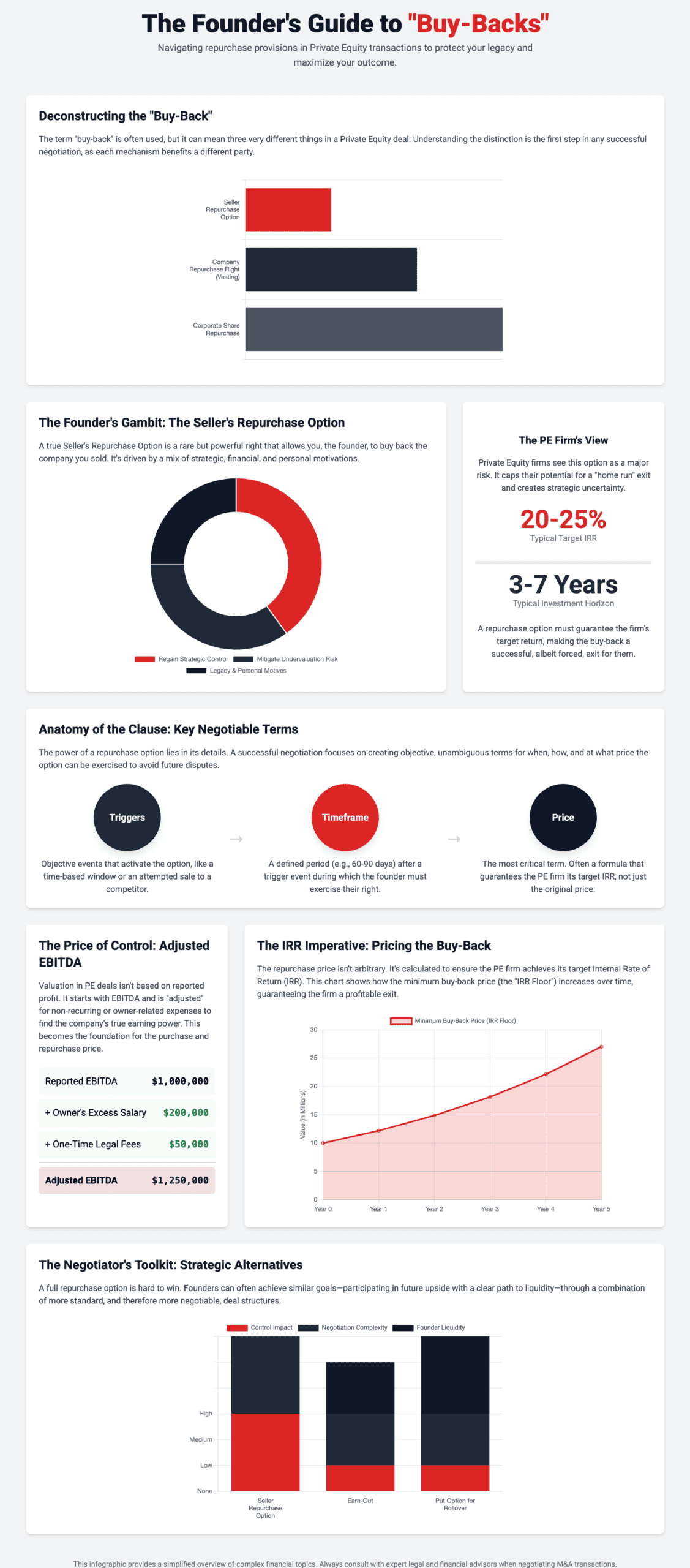
Implications for Private Equity Firms
While a buyback provision undeniably benefits the seller, it concurrently introduces an layer of complexity for the private equity firm’s investment. The firm must account for the possibility of their stake being repurchased, which can influence their long-term investment strategy and potential returns. Consequently, these provisions are subject to meticulous negotiation and frequently include specific triggers that must be satisfied. For example:
- The provision might only be exercisable after a predetermined number of years.
- It might only be triggered if the company’s performance declines below an agreed-upon threshold.
The inclusion of a buyback provision clearly exemplifies how private equity agreements are customized to strike a balance between the interests of both the investor and the original business owner.
A Conceptual Model of a Buyback Provision
To illustrate the practical application of a buyback provision, consider the following conceptual model:
Imagine a private equity firm invests $10 million in a company in exchange for a 40% equity stake. The company’s founder retains the remaining 60%. As an integral part of the deal, a buyback provision is negotiated.
Key Terms and Conditions
- Investment: The private equity firm invests $10 million for a 40% stake.
- Initial Valuation: The company is initially valued at $25 million ($10 million / 0.40).
- Buyback Right: The founder possesses the right to repurchase the private equity firm’s 40% stake.
- Buyback Period: The right can be exercised between the 3rd and 5th anniversary of the deal.
- Buyback Price Formula: The price is calculated as a predetermined multiple of EBITDA (Earnings Before Interest, Taxes, Depreciation, and Amortization). A common formula might be 5 times the average EBITDA of the preceding two years.
Scenario 1: The Company Performs Well
- Year 4: The company’s average EBITDA for the preceding two years is $8 million.
- Buyback Price Calculation: The buyback price is $40 million (5 x $8 million).
- Outcome: If the founder chooses to exercise the buyback, they would need to pay $40 million to repurchase the private equity firm’s 40% stake. This represents a substantial premium over the initial $10 million investment, directly reflecting the company’s increased value.
Scenario 2: The Company Underperforms
- Year 4: The company’s average EBITDA for the preceding two years is only $3 million.
- Buyback Price Calculation: The buyback price is $15 million (5 x $3 million).
- Outcome: The private equity firm’s stake is still valued at more than their initial investment, but the return is lower compared to the high-performance scenario. The founder could still buy back the stake, albeit at a less favorable valuation than in the first scenario.
This model clearly demonstrates how the buyback price is not static but rather intrinsically linked to a performance metric. This linkage ensures that the private equity firm is appropriately compensated for the company’s growth, even in the event that their stake is repurchased. Ultimately, it highlights the inherent balance of risk and reward that this type of provision presents for both the founder and the private equity firm.

fellowship program
A unique community designed to help entrepreneurs scale their businesses through mentorship, workshops, and networking.
Ready to elevate your business?
See if you qualify to join our exclusive community of business owners.

the first habit
The First Habit by Lewis Schiff emphasizes the importance of setting clear goals and taking action to achieve them. It encourages readers to define their vision,create a plan, and stay focused on their objectives.

About the Author
Lewis Schiff is the Chairman of the Board of Experts for Birthing of Giants and the Executive Director for Moonshots & Moneymakers. He is the author of several books on success and a columnist for Forbes and Worth Magazines.
