
How I Did It: Turn a Social Cause into a For-Profit Business
When Ron Steptoe founded Warrior Centric Health, it had two goals:
to improve healthcare for underserved populations—and make a profit.
His company is proof that turning a profit and creating social good are not mutually exclusive. In fact, as a for-profit company, Warrior Centric Health is incentivized to bring greater efficiency to its mission, ultimately allowing it to reduce healthcare costs for patients and providers alike. Here are five ways Ron has been able to make this happen:
- Lay your claim to an underserved market. Underserved communities are underserved for a variety of reasons, not the least of which is they offer little return on investment— that is unless you find an innovative way to meet their needs. That is exactly what Warrior Centric Health has done by helping health systems treat the veteran and military communities. As the first to define this market, the company can build upon its first-mover advantage.
- Leverage your knowledge as well as your passion. It might seem self-evident, but passion for a cause, no matter how great, is simply not enough to drive success. Ron spent years in the pharmaceutical industry learning the value of data while also working side by side with medical professionals to understand what they needed to help their patients. With Warrior Centric Health, he was able to combine this knowledge with his entrepreneurial spirit to create a service that filled a need for paying customers (healthcare providers) as well as the veteran and military communities he wanted to serve.
- Determine the best kind of financing. One thing Ron took away from his participation in the Birthing of Giants Fellowship Week is that not all funding is created equal. He decided that pursuing venture capital with the ultimate goal of selling to a larger company was the best way to achieve his mission, but you may well come to a different conclusion—such as growing organically toward a public offering or gaining the administrative resources of a private equity acquisition.
- Understand that the value of data is multiplicative. Ron realizes that the data his company collects has value well beyond the purpose it currently serves, which is to provide education. As technologies such as artificial intelligence continue to advance, this data could yield new insights into population health.
- Be strategic with your partnerships. Partnerships are a great way to extend the influence and growth potential of your business. By working with the Department of Defense, Warrior Centric Health gains not only a paying customer but also a valuable partner that provides the data that drives the company’s growth. And working with Microsoft puts its products right in front of the customers it needs to reach.
Curious to know how Ron is building a for-profit company with an impactful social agenda? Read the PDF for the full story.

fellowship program
A unique community designed to help entrepreneurs scale their businesses through mentorship, workshops, and networking.
Ready to elevate your business?
See if you qualify to join our exclusive community of business owners.
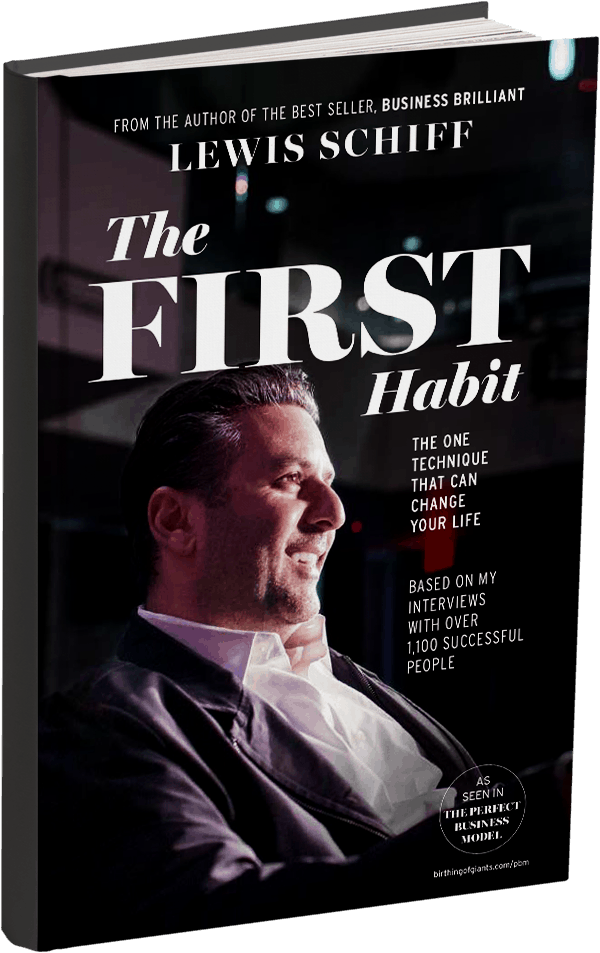
the first habit
The First Habit by Lewis Schiff emphasizes the importance of setting clear goals and taking action to achieve them. It encourages readers to define their vision,create a plan, and stay focused on their objectives.

About the Author
Lewis Schiff is the Chairman of the Board of Experts for Birthing of Giants and the Executive Director for Moonshots & Moneymakers. He is the author of several books on success and a columnist for Forbes and Worth Magazines.
