

A New Book by Lewis Schiff
Chairman of Birthing of Giants
Author, Business Brilliant and The First Habit
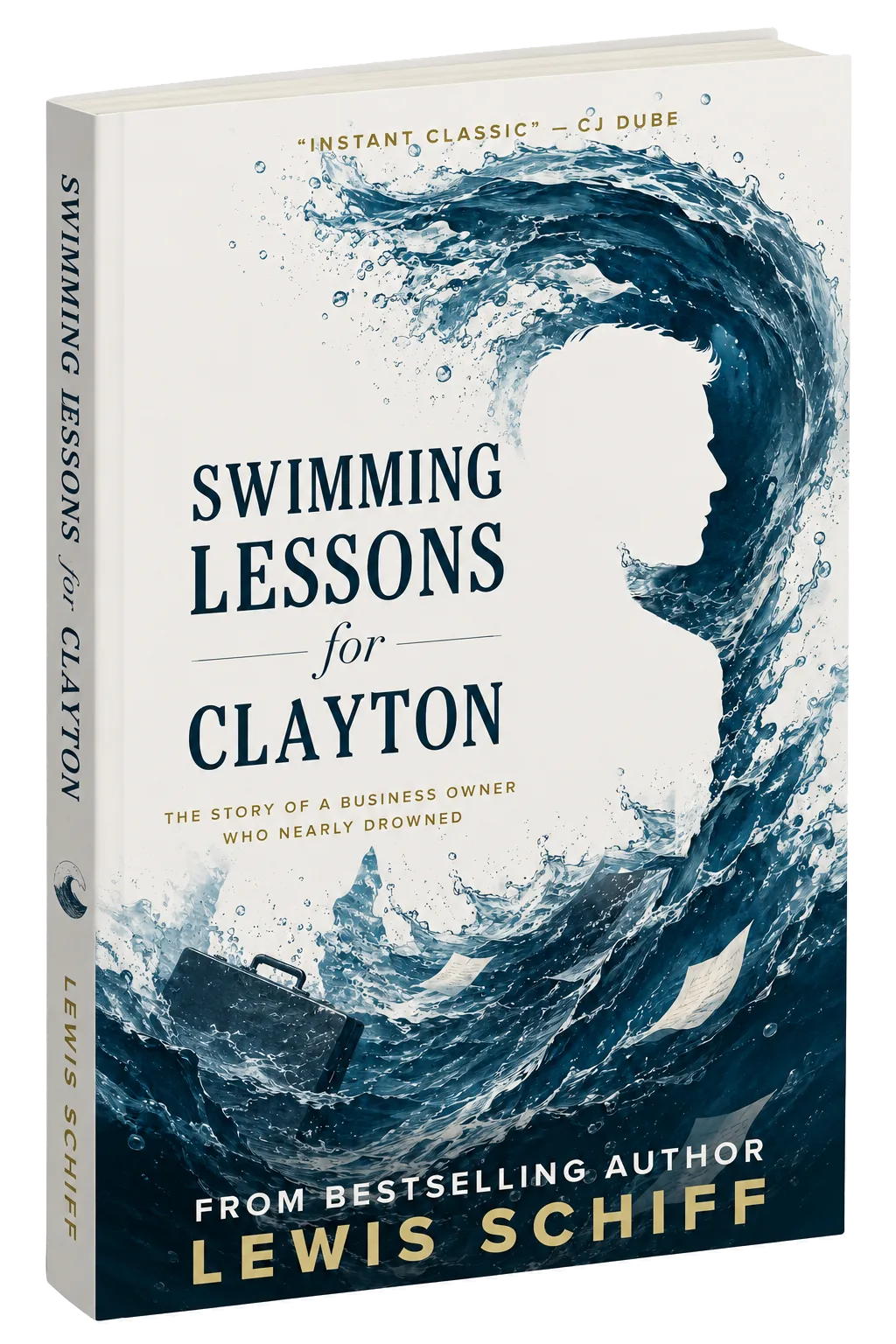
Swimming Lessons
for Clayton
The Story of a Business Owner Who Nearly Drowned
Not many business owners will ever meet a mentor like Mr. Gi. In Swimming Lessons for Clayton, Mr. Gi appears when Indiana business owner, Clayton Thomas, needs him most.
During their friendship, Mr. Gi shows Clayton how to build a great business. As the reader discovers, Mr. Gi has a good reason for helping Clayton that goes beyond simple generosity — a connection between their two families that spans generations and continents.
Get a Free Excerpt of Swimming Lessons for Clayton
The email waitlist form requires JavaScript and will appear when the interactive page loads.
The story of Clayton and Mr. Gi arrives November 2026. Join the waitlist and we'll send you a free chapter the moment it's ready to ship!
"An Instant Classic" — CJ Dubé
Why Lewis Wrote It
Someone once asked me,
“Who needs swimming lessons most of all?”
“Someone who’s drowning,” I replied.
“And who has the least time for swimming lessons?”
“Someone who’s drowning.”
That’s the story of every business owner — measuring every day by whether they drowned a little, managed to tread water, or actually swam somewhere. And that’s where the story begins.
About the Author
Lewis Schiff, Chairman of Birthing of Giants
Lewis Schiff is the Chairman of Birthing of Giants, a fellowship program for business owners ready to scale, exit, or step back. He is the author of Business Brilliant and The First Habit.
Birthing of Giants has served 300+ graduates, 200+ Inc. 5000 companies, and helped create $3B+ in value over more than 30 years.
Frequently Asked Questions
What is Swimming Lessons for Clayton about?
It is a business novel by Lewis Schiff about Clayton Thomas, an Indiana business owner who nearly drowned, and Mr. Gi, the mentor who teaches him how to build a great business. As the story unfolds, Mr. Gi reveals a connection between their two families that spans generations and continents.
Who is the author?
Lewis Schiff, Chairman of Birthing of Giants and author of Business Brilliant and The First Habit.
When does it come out?
The book arrives in November 2026.
How can I get a free excerpt?
Join the waitlist with your email address and we’ll send you a free chapter the moment it’s ready.
Is it fiction or a business book?
It is a business novel — a work of fiction that teaches real lessons about building and running a company, in the tradition of business fables.
Who should read it?
Business owners and entrepreneurs who feel like they’re treading water and want a mentor’s perspective on how to build a great business.
More About the Book
How I wrote the book
On August 8, 2024, my father, Arthur Schiff, died at the age of 85 from a heart attack at Memorial Sloan Kettering Cancer Center in New York City. When he passed, I was at Oxford University in the UK, giving a lecture to a group of business owners. My son, Jake, 20 at the time, had joined me on the trip. As soon as we heard the news, we set out for Heathrow Airport and headed back home.
One year later, almost to the day, Jake and I were at the gravesite of my father’s favorite author, Philip Roth, in upstate New York, where Dad had asked us to spread his ashes. As Jake and I shared some memories, I could feel pain up and down my spine. Within a few hours, I was at the local emergency room where I was told I was having my own heart attack. Besides him being my best friend, my father’s two other gifts to me were a 2010 Volkswagen with 150,000 miles on the odometer and a lousy ticker.
At home, resting during the waning days of that summer, I felt a story stirring inside me. It’s not uncommon for someone to work out their grief by writing. I started to put the story down on paper. Since I run a school for business owners, the story was about the trials and tribulations of a business owner who takes over a family business from his father. You don’t have to be a Freudian scholar to understand that I was working out feelings between me and my own father. The story would eventually become Swimming Lessons for Clayton.
When I finished, I shared it with a friend, Mark Ganem. Mark is a gifted writer and editor whom I know from my days in the now-largely-defunct New York magazine industry. The folks I met in that industry were by far the most colorful and talented people I’ve ever had the pleasure to work with. Most people think they understand what a person with the title of “editor” does, but they probably don’t. In my experience, there’s a great editor behind every great writer you’ve ever loved. They are the unrecognized collaborators behind your favorite books and articles. They turn thoughts into prose and good storytellers into great writers, and yet they rarely get more than just an acknowledgment in the back of the book. Other than their industry reputation, you usually don’t find out the extent of their reach until you read about their work history in their obituary—such is the nature of the unsung hero-editor.
When I shared the story I wrote with Mark, he told me he liked it. That meant a lot to me. Mark is like most great editors: he knows how good he is, so he doesn’t want to waste time with trash, even for a personal friend. We talked about whether the story I had written could become an actual book. It’s important to understand what an editor does here: they help take relatively raw material and pour a lot of love into it to turn it into structured prose that the audience can relate to. I don’t care if we’re talking Hemingway or Schiff, the editor’s hand is always part of a successfully told story. So, when Mark said he liked the work and thought it could become a book, that was an important moment of validation for me.
I asked for his help. He agreed. We set up a process, a timetable, and a price, and got to work. At the beginning, Mark told me he wanted to build out a co-editor that would work alongside him—one made entirely out of artificial intelligence tools. Among the interests that Mark and I share is a love of technology. I immediately agreed, and worked alongside him as we built out an entire “Clayton-brain” inside Claude, the AI platform. The brain included:
- A description of every single character and place in the book, even if those details would never appear in the story.
- A chronology of the story, carefully charted out over a 15-year period, sometimes with several entries for a single day.
- Values that each character possessed that would have to remain true for the duration of the story.
And so much more. We even regularly had an AI book editor responsible for acquisitions of new material review our work to see if they would recommend buying or passing on the manuscript and why.
To say that Mark and I geeked out on creating a Clayton-brain would be an understatement. We probably spent as much time on the brain as we did on the manuscript itself.
Now, here’s the rub. Mark is a great editor and, like any great editor, he helped me turn a very rough draft into a thoughtfully built narrative. He and I willingly enlisted the Clayton-brain to co-edit alongside Mark because we thought it would help the story get told and we thought it would be an exciting challenge to build it. It did and it was. I love the story we co-created and am thrilled to make it available to those who want to read the tale of a swashbuckling business owner in Cloverdale, Indiana, and how he survives and becomes a great leader. It incorporates the lessons I’ve learned and teach at Birthing of Giants, and I think it creates an emotional understanding of what it means to be an entrepreneur, although I’ll leave that conclusion to the reader.
That Mark edited with the help of an AI tool seems to be—as of the time of this writing—a source of great controversy. I will share where I stand and each reader can decide for themselves where they stand. I believe in the power of technology to make the world a better place. And I believe our own lives coinciding with the emergence of artificial intelligence, among other powerful technologies, is one of the most exciting aspects of this moment in history.
In my opinion, simple questions like “Did AI write this?” misunderstand how Mark used AI to edit this story. For one, editors have always helped writers develop their ideas for a living. So, for anyone who thinks their rejection of an AI-assisted writing process is a way to protect the financial interests of editors, they shouldn’t have any fear here. Mark was paid fairly for his services.
Secondly, for those who personally object to using technology in the process of writing, I recommend you consider the number of ways that technology is part of every creation already, from using spell-check in your Microsoft Word documents to using the internet to look up facts like when and where things took place.
And finally, there’s a growing chorus in the year 2026 that AI is getting really good and therefore to reject its use is to reject quality. I agree. When I wrote a line in Swimming Lessons for Clayton that two characters met up when it was unseasonably warm, The Clayton-brain suggested a revision because it had looked up the weather on that particular day in Indiana and found that it was not, in fact, unseasonably warm. (I rejected the Clayton-brain’s recommendation, one of many acts of free will I managed to exercise during the writing process.)
Clearly, the world is reckoning with the power and influence of AI right now. I have decided that it’s a tool that can help more than anything else. I have said many times: If AI can cure cancer, do you really care where the answer came from? That may sound like hyperbole, but as I write this, OpenAI, another prominent AI platform, has just released mountains of solutions to mathematical problems that have set the math world ablaze. These math solutions connect to everything from engineering to medicine, so to discount them as brainteasers and not material advances in our daily lives is to miss the point entirely.
Mark is a great editor, and his creation of a Clayton-brain made the story better. He deployed his skill and his talents to do this work and I am grateful to him for helping me bring Clayton’s story to life. I hope you enjoy Clayton’s story as well.
Acknowledgments
This story, Swimming Lessons for Clayton, has been gathering inside of me for a while, but it took some personal tragedies before I was willing to sit down and reckon with it. I’m glad I did. In the summer of 2025, I began this story with a phrase that a friend of mine, someone with an easy grasp of pithy phrases, once shared with me. He said:
“You know who needs swimming lessons the most? Someone who’s drowning! And you know who has the least time for swimming lessons? Someone who’s drowning!”
We were talking about why business owners struggle to find the time to work “on” their business because they are so busy working inside of their businesses (thank Michael Gerber of The E-Myth for that bit of wisdom), and when Chris Quinn shared that drowning quip with me, I thought it was about the most clever thing I’d heard in a long time. It’s also true. Business owners spend so much time worrying about today’s fires that they miss the tsunami that’s about to sweep their entire business away.
The school I run, Birthing of Giants, is designed to teach business owners how to swim rather than drown. So, the first person I want to acknowledge in this acknowledgments section is the business owner. I know you have a lot of problems staring you down today, but your real legacy, like Clayton’s, will come from seeing the bigger picture. If today was a day that you worked inside your business, not to worry. Tomorrow is another day. Call me and we’ll discuss what it will take to teach you how to swim.
The rest of the folks I want to acknowledge in the writing of this story are the ones who inspired it: my students, colleagues, and friends. They’ll be easy to spot in the book because I usually changed their names around just a little bit, but, for example, it won’t be that difficult for Tim Hart to find himself (Tim Hartz) or Van Sullivan (Vance Sullivan) and so on. That’s not always true. Sometimes the characters are amalgams of several people at once. So here is a (hopefully) complete list of individuals who inspired this story (in order of appearance):
Clayton Tomasino
Kim Lawton
Lauren Hochenberger
Stephanie Muse
Tim Hart
Norm Brodsky
CJ DuBé
Manny Velez
Jake Schiff
Doug Tatum
Evren Ozkaya
Claudia and Clyde “Butch” Muse
Van Sullivan
Sir Steven Wilkinson
Larisa Genin
Stephen Bennington
And then there are the two wonderful people who dedicated themselves to the story by giving me their days, nights, weekends, and received my constant torments for them to move faster. First, Mark Ganem, a great editor and friend who saw that there was something worthwhile in Clayton’s story and helped me get it on paper. This project would have died on the side of the road if it weren’t for him.
Second, Stephanie Muse, my partner, who donated her brain and talents—along with her strongly held opinions about what each of the characters in Cloverdale would do, and would never do, as if they were her closest personal friends. She edited, wrote, argued, and cajoled to make this story, and me, better. Thank you.
Thanks, also, to the team at Birthing of Giants, beginning with Lauren Hochenberger, who are responsible for promoting the book and getting copies in the hands of readers. Small companies like ours depend on the efforts of hard-working, caring, loyal people like all of you. When I wrote about “Flo Sherman” in the book—"Rose Thomas had asked her best friend to come work at a struggling factory for less than she was worth, and now, at last, the company was worth her"—that’s my goal every day, as well: to build a company that’s worthy of you all.
Visiting with Mr. Gi and the Six Steps to a Bigger Business
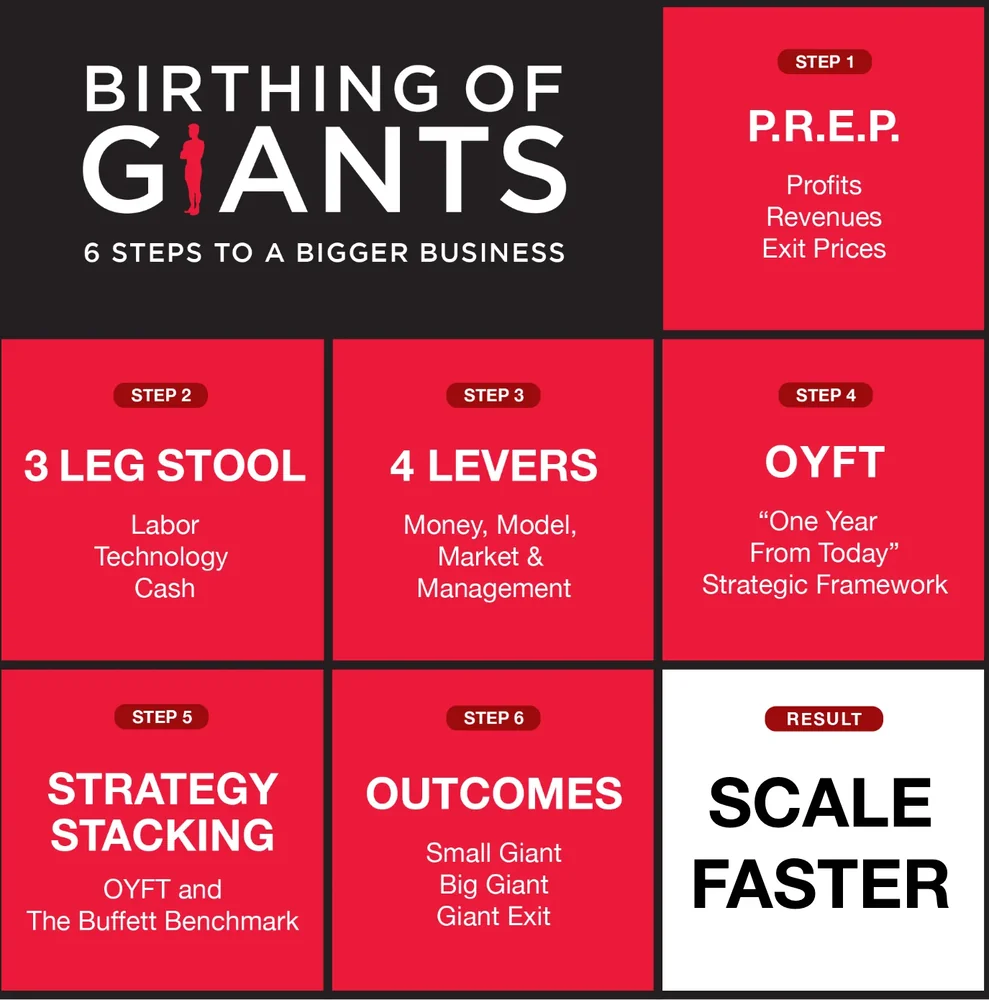
During the book, Swimming Lessons for Clayton, Clayton visits with his mentor, Byeong-Ok Gi, five times. Each of these visits corresponds with Birthing of Giants' Six Steps to a Bigger Business.
The first time Clayton ever meets Mr. Gi in person, it’s in a boardroom in Indianapolis. While there, Gi will introduce Clayton to step one, “P.R.E.P.,” or “Profits, Revenues and Exit Prices” and step two, “Labor, Tech, and Cash, the Three Legs of the Stool”.
The next time, at the SunWise campus outside of Seoul, South Korea, Clayton is introduced to step three, the four “M’s” that Doug Tatum made famous in his book, No Man’s Land.
For the next two visits, Clayton learns about “One Year From Today” (step four) and “Strategy Stacking” (step five) while visiting Mr. Gi’s home in Seoul, South Korea.
And Clayton’s final lesson takes place on a former wheat field in Wichita: “The Three Outcomes: Small Giant, Big Giant, Giant Exit” (step six), where, for the first time, Clayton arrives at the answers before Mr. Gi leads him there. That’s when we know that Clayton’s education from Mr. Gi is largely complete.
Birthing of Giants’ Six Steps to a Bigger Business is a method to grow a business thoughtfully, depending on each entrepreneur’s temperament and appetite. Every business owner can build a business no greater than their limitations and won’t rest until they’ve fully reached their ambitions. Therein lies the struggle.
And what a wonderful struggle it is! To get the chance to create a complex, successful, profitable business that brings strangers together towards a common goal is one of the greatest challenges and joys a person can undertake. Not only have I had the opportunity to do this several times, I am surrounded by others who do the same. It is a privilege.
Swimming Lessons for Clayton is dedicated to all the great business owners who’ve journeyed through the Six Steps to a Bigger Business with me and those who are still to come. — Lewis Schiff
P.S. Clayton’s mentor, Mr. Gi? His full name is Byeong-Ok Gi, whose initials are “B.O.G.” — the same as Birthing of Giants, the school for business owners that I run. Hint: more easter eggs to be found.
About The Author

Lewis Schiff is the chairman of Birthing of Giants, a school for business owners. In addition to selling two businesses (The Armchair Millionaire to iVillage/NBC in 2000 and MainStreet.com to TheStreet.com in 2009), Schiff has written or co-written several books (The Armchair Millionaire, The Middle Class Millionaire, Business Brilliant, The First Habit, and others) about small business and business owners whose experiences exemplify the American Dream. Whether for Inc. Magazine—where he ran the Inc. 5000 community for years—or Forbes Magazine or on podcasts and on stage, Schiff loves to share his perspectives on “behavioral entrepreneurship” and what it takes to succeed in America.
His most recent book, Swimming Lessons for Clayton: The Story of a Business Owner Who Nearly Drowned, is an entirely new kind of book for him—a work of fiction. The story emerged from his own experience after his father passed away at the age of 85 from a heart attack, followed by his own heart attack one year later when he was 55 years old. What became Swimming Lessons for Clayton began as a healing journal during his recovery. The book tracks the story of Clayton Thomas Jr., a fictional business owner who leads OptiGuard, a business his father began thirty years earlier, to success. During the course of the story, the reader is invited into a transcontinental, transgenerational journey that reveals what it takes to create a great leader.